

Safe Download 100% Clean and Virus Free

Secure Online Payment

30 Days Money-back Guarantee

Free Customer Service within 24 hours
$179.99$49.99
GiliSoft Audio Toolbox is designed for work that moves between recording, editing, cleanup, conversion, speech processing, and music-library tasks. It keeps the most frequently used audio utilities in one place instead of requiring a separate application for every step.
Record a lesson or podcast, remove noise and silence, cut or join clips, convert the result, update track information, or prepare Audio CDs from the same suite. Users who only need one specialized task can still choose a dedicated GiliSoft audio product.
These are the everyday tasks most users expect from an audio toolkit: record, convert, clip, join, mix, and clean audio without switching between separate apps.
 Audio Recorder
Record computer sound and microphone input for lessons, voice notes, podcasts, demos, and spoken guides.
 Converter
Convert audio and extract sound from video so files are easier to edit, archive, share, and reuse.
 Cutter and Batch Cutter
Clip one file or many files quickly when you need shorter samples, ringtones, lesson segments, or social snippets.
 Joiner and Splitter
Merge multiple tracks into one file or break a long recording into smaller parts for chapters, modules, and highlights.
 Mix
MixBlend voice, background music, and other audio layers when you want a fuller final track without using a separate workstation.
 Video to MP3
Extract audio from video for reuse in music libraries, tutorials, lesson assets, voice analysis, or simple listening tasks.
This group focuses on improving clarity, reshaping sound, and making rough recordings easier to publish or share.
Reduce background noise, hiss, mic interference, and room distractions, then remove long silent sections from spoken recordings.
Reduce file size or smooth volume behavior when you need smaller exports and more controlled playback levels.
Adjust frequency balance to improve perceived clarity, add warmth, or make music and spoken tracks sound more polished.
Even out track loudness so recordings feel more consistent across lessons, playlists, episode segments, and exported clips.
These tools are more specialized, but they help when the work centers on speech, vocals, training material, and creator audio.
 Adjust Speed and Change Voice
Modify playback speed, pitch, and voice character for practice, creator tasks, narration experiments, and quick spoken edits.
 Vocal Separation
Separate human voice from background music when you need karaoke-style results, remix prep, or clearer vocal analysis.
Create similar-sounding speech output for repeatable narration experiments and AI-assisted voice tasks.
Turn written content into spoken output for study aids, scripts, preview audio, and simple accessibility tasks.
Transcribe spoken material into text when you need drafts, captions, notes, or searchable written versions of audio content.
These support tasks are useful when the job includes music organization, physical media, or simple library maintenance.
 CD Burning
Burn favorite audio files to CD for playback, sharing, archiving, or simple offline listening tasks.
 CD Ripper
Extract music from audio CDs for backup, format conversion, library organization, and device-friendly playback.
 ID3 Editor
Edit tags such as artist, album, title, year, track number, and comments so music libraries stay organized and searchable.
Preview the main tools included in the suite: recording, editing, conversion, CD ripping and burning, vocal separation, denoise, silence removal, compression, and speech-related utilities.
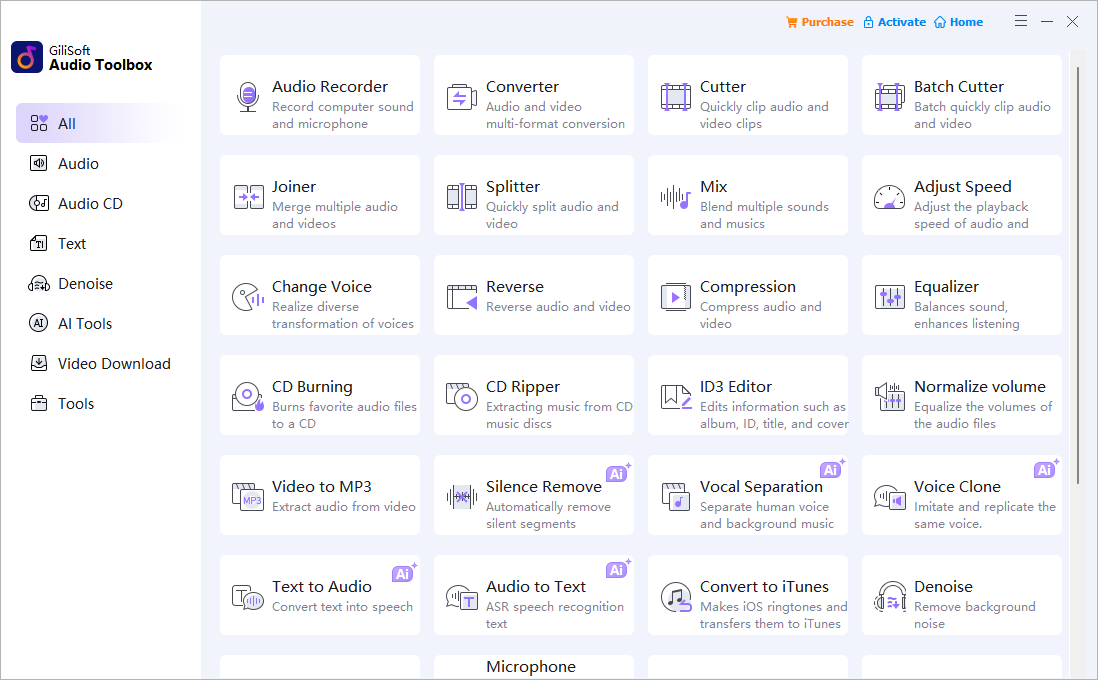
Start from the main suite screen and choose the task you need: record, edit, convert, clean, separate vocals, process speech, or work with CD audio.
Record voice, remove silence, cut segments, normalize volume, and export practical files for publishing.
Build clearer spoken guides, course narration, classroom support files, and training modules from recorded or imported audio.
Convert formats, extract sound from video, compress files, update ID3 information, and prepare device-friendly output.
Use text to audio, audio to text, vocal separation, voice tools, CD ripping, CD burning, and tag editing in one suite.
Yes. It works well for spoken lessons because it combines recording, trimming, silence removal, cleanup, and export tools in one suite.
Yes. The suite is built for users who need to record audio, edit clips, split or join files, and convert the result without switching to separate apps. See audio recorder, editor, and converter and audio recording and editing suite.
Yes. It includes both text-to-audio and audio-to-text tools, which makes it useful for voice, lesson, and speech-based tasks.
It is a better fit when your work spans recording, editing, conversion, cleanup, and spoken-audio tasks. If you only need one specialized function, a single-purpose product may be enough. See audio toolbox for Windows, all-in-one audio editing software, and audio format converter and editor.
Yes. It can help clean up voice recordings with tools for denoise, silence removal, trimming, volume adjustment, and format conversion. See clean up audio recordings, remove silence from audio files, audio denoise software for Windows, audio suite for spoken content, and audio tools for spoken lessons.


Enter your email address to get our latest newsletter