
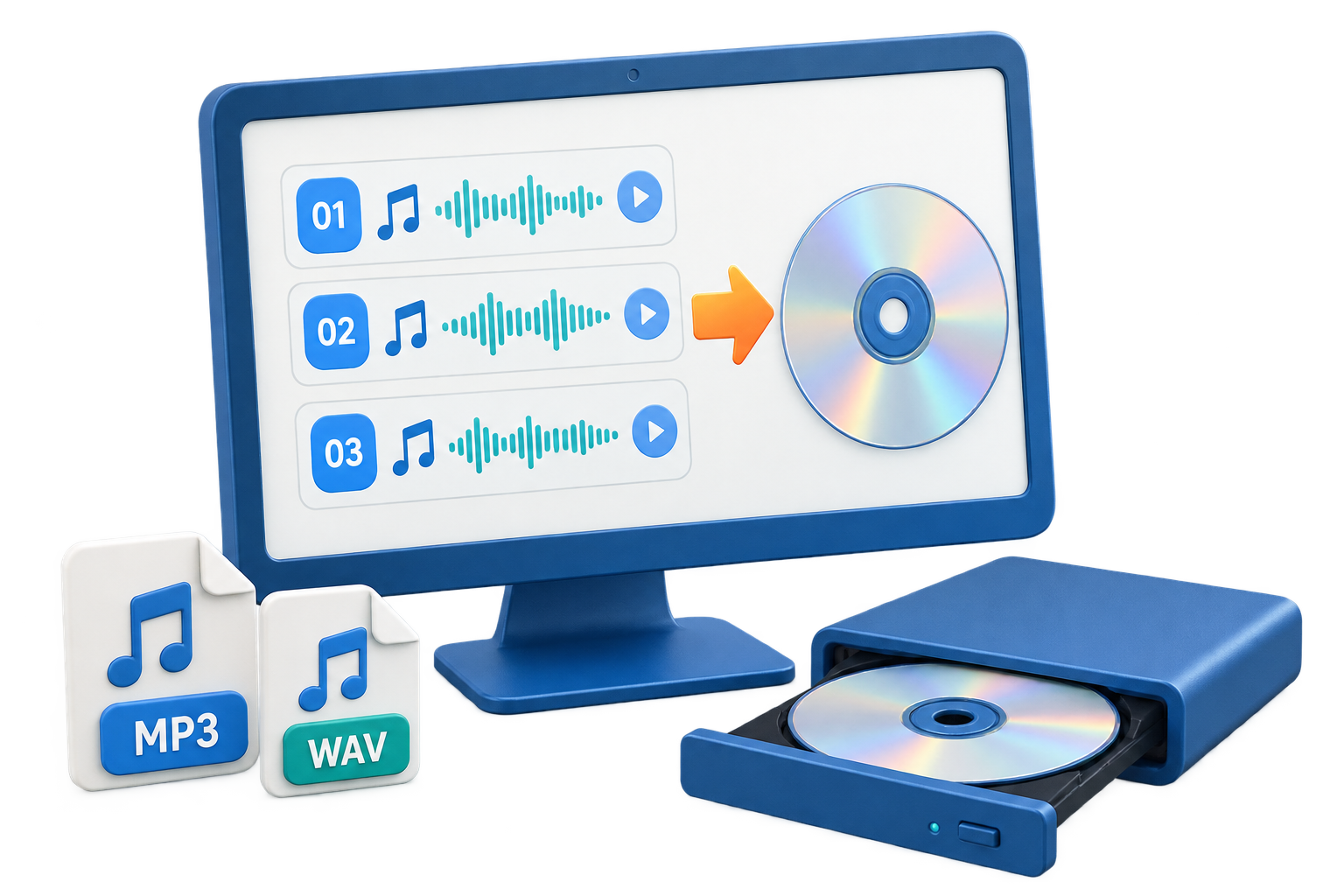
Audio CD or Data Disc: Choose Before You Burn
Quick answer: Choose Audio CD when the disc must play in a traditional car or home CD player. Choose an MP3 or data disc only when the destination device explicitly supports those file types. A typical Audio CD is planned by playing time, commonly up to about 80 minutes, rather than by the number of source megabytes.
| Playback or workflow | Recommended output | Important check |
|---|---|---|
| Traditional CD player | Standard Audio CD | Broadest playback compatibility |
| MP3-capable car stereo | MP3 CD | More tracks, but device support is required |
| Computer archive | Data CD or disc image | Preserves files rather than CD-audio behavior |
| Reusable test media | CD-RW only if supported | Older players may reject CD-RW |
Before You Start
A successful burn begins with the destination player, compatible blank media, and a reviewed source list. Decide those details before the optical drive starts writing.
Confirm the player
Read the device manual for Audio CD, CD-R, and CD-RW support.
Check total playing time
Plan the Audio CD by minutes and leave space rather than filling it to the limit.
Prepare clean sources
Listen for clipped starts, long silence, inconsistent volume, or the wrong version.
How to Burn an Audio CD on Windows: Step by Step
Insert compatible blank media
Use a writable CD recognized by the burner. CD-R is usually the safer choice for older playback hardware.
Choose Audio CD output
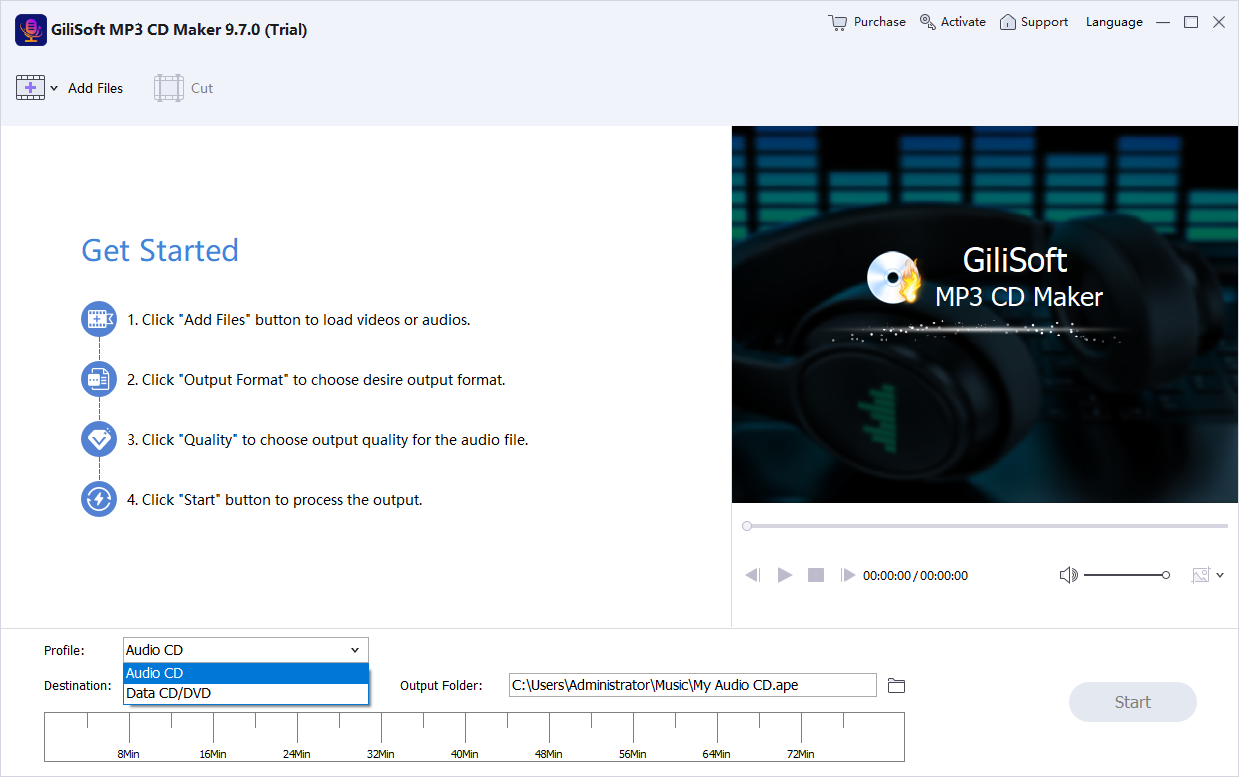
Open GiliSoft MP3 CD Maker and select the standard Audio CD task rather than MP3 or data-disc output.
Add and arrange the music
Import supported audio or video sources, remove unwanted entries, and place every track in final playback order.
Trim and preview when needed
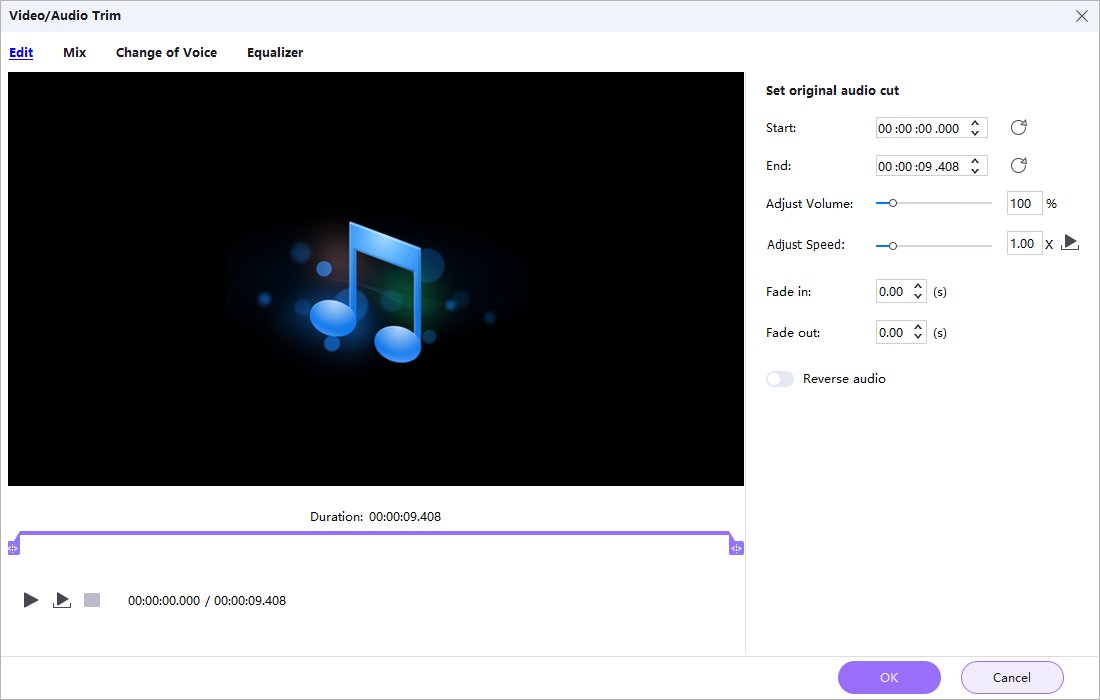
Set a start point and duration for long sources, then preview edited tracks before the physical burn.
Select the recorder and burn
Confirm the correct optical drive, review capacity and burn settings, then keep the computer powered and stable until completion.
Reinsert and test the disc
Test the opening, middle, and final tracks in the destination player before labeling or distributing the CD.
Improve Disc Reliability and Playback Compatibility
Prefer compatibility over capacity
Use Audio CD and CD-R for older hardware unless its manual confirms compressed-disc and CD-RW support.
Keep track order deliberate
The order in the project becomes the listening sequence, so check it before starting the burn.
Avoid multitasking during writing
Pause heavy disk activity and prevent sleep or shutdown while the optical drive is writing.
Verify on real hardware
Successful writing is not the same as compatible playback. The destination player is the final test.
Recommended Windows Tool: GiliSoft MP3 CD Maker
GiliSoft MP3 CD Maker provides a focused Audio CD mode, source import, track ordering, trimming, recorder selection, multiple-copy output, and supported image creation in one Windows application.
- Create standard Audio CDs or MP3/WMA music discs from the appropriate mode.
- Import common audio formats and selected video sources when their soundtrack is needed.
- Arrange, remove, trim, mix, or preview material before committing it to disc.
- Test a finished disc before making copies or distributing authorized content.
Troubleshoot Common CD Burning Problems
| Problem | Likely cause | What to do |
|---|---|---|
| Disc is not recognized | Wrong disc type, unsupported CD-RW, or session issue | Try a fresh CD-R in Audio CD mode and confirm the disc is closed |
| Some tracks are missing | Project exceeded available playing time | Reduce the list and burn the remaining tracks to another disc |
| Track starts too early or late | Source contains silence or unwanted material | Trim and preview the source before burning again |
| Burner is not listed | Windows does not detect the optical writer | Reconnect the drive and confirm it appears in Windows before reopening the software |
Burn Only Music You Are Authorized to Copy
Use your own recordings, public-domain material, or music for which you have suitable copying and distribution permission. Purchasing access or being able to play a stream does not necessarily grant the right to duplicate it, and technical protection should not be bypassed.
Frequently Asked Questions
Is an Audio CD the same as an MP3 CD?
No. A standard Audio CD stores CD audio for broad player compatibility and is normally limited by playing time. An MP3 CD stores compressed files as data and works only in players that support MP3 discs.
Should I use CD-R or CD-RW?
CD-R is generally the safer choice for older car and home players. CD-RW is reusable, but many older devices do not support it reliably. Check the destination player manual.
Why does the disc play on my PC but not in the car?
The car player may not support the selected disc type, file format, recordable media, folder structure, or an unclosed session. Test a standard Audio CD on CD-R when broad compatibility is the priority.
What should I test after burning?
Test the first, middle, and final tracks on the actual destination player. Also confirm track order, navigation, silence between tracks, and that the disc starts after reinsertion.
Can I burn downloaded or streaming music to CD?
Only burn music you own or are authorized to copy. A playable source does not automatically grant duplication or distribution rights, and protected streams should not be bypassed.
Can GiliSoft MP3 CD Maker use audio from a video file?
Yes. The product supports selected video sources when their soundtrack is needed, alongside common audio formats. Review the extracted track before burning.
More Audio CD and Music Disc Guides
Continue with the disc format, production method, or complete product guide that matches the next task.